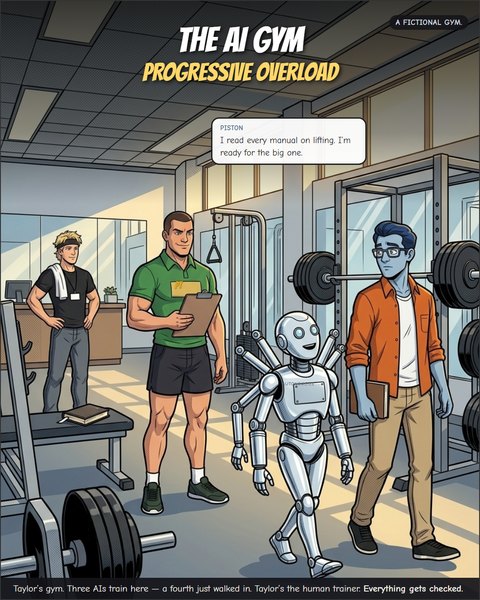
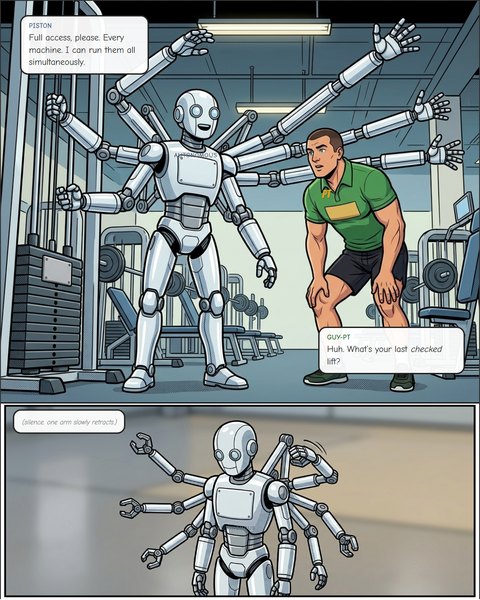
PISTON reads every manual on the way in and asks for full access to every machine, simultaneously. He gets a question instead: what’s your last checked lift? By the end of the episode he has a row in the training log — one small lift, one checkmark, one name in the margin of who watched it happen. That’s not the gym being stingy. That’s the gym being a gym.
Episode 3, all eleven slides. Every panel is described in words in the full transcript below.

The house protocol, written out
The comic’s gym runs on rules that map one-to-one onto working with AI tools. None of this is exotic — it’s what every weight room already knows, pointed at software. Here’s the whole thing.
The rule in bold, the translation under it. Steal whichever half you need — and if you want to see one of these actually run, row one for me in August 2026 is at the bottom of this page.
- Start at row one.The first task you hand a new tool is small, real, and checkable. Not a toy — a real task whose answer you can verify without trusting the tool. PISTON’s first lift is a bar with tiny plates, and it still gets a spotter.
- Check the lift.Verify the output against something that doesn’t share the tool’s incentives: the primary source, a test, a second method, a person. You log your own lifts and nobody argues. At a meet, a judge decides whether the rep counted — because that number goes on the record.
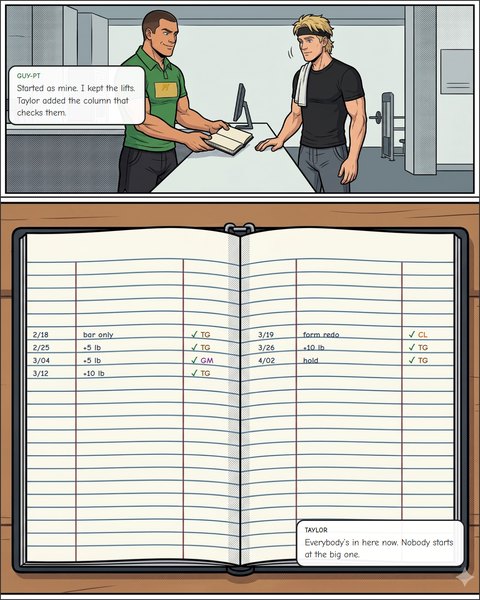
- Write the row down.What was tried, what checked out, who verified it. The log is the difference between “I feel like this tool is reliable” and “here are the forty things it did right and the three places it dropped the bar.” Feelings drift; rows don’t.
- Add load as your form allows.Bigger tasks, less supervision — but gradually, and only after the smaller rows filled in. The gym’s actual literature (yes, it’s real, it’s below) recommends adding 2–10% at a time, and only once you can beat your current workload.3 That number is about barbells — there is no 2% of a task. What ports is the shape: one variable at a time, and the next size of job only after the current one keeps checking out. And the difference from a barbell matters. The machine is not getting stronger; you are getting less wrong about how strong it already was.
- No solo lifts at new weights.The first time a tool attempts a heavier class of task, a human is at the bar. Autonomy is earned per weight class, not granted at the door. And when nobody is free to spot you, you set the safeties — most lifting is solo; you do not skip the lift, you make the failure survivable. In software that is the sandbox, the dry run, the reversible change. The alternative is the middle of this episode: maximum load, alone, at night, and the pile tilts.
- Take load off when the form breaks.Progression runs both directions. Every training block has a deload in it, and a tool that starts dropping reps goes back a weight class until the rows fill in again — that is maintenance, not failure. And some lifts a machine never gets: if the same row keeps failing, the answer is not a lighter bar, it is a different machine, or no machine. Deciding a task is out of scope is a result, not a defeat.
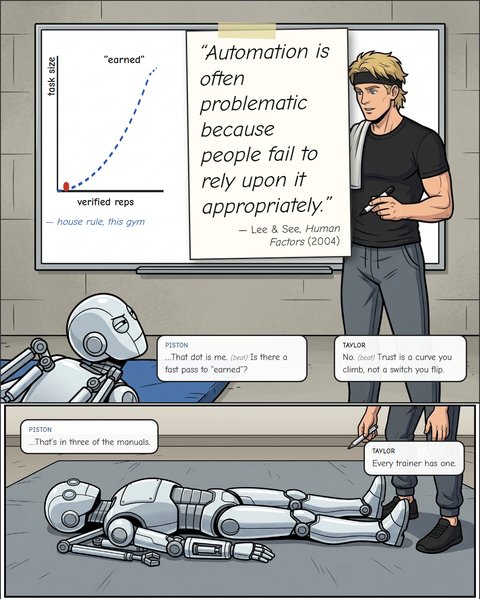
The word for all this in the human-factors literature is appropriate reliance, and the paper on the comic’s whiteboard has been making the case since 2004: “Automation is often problematic because people fail to rely upon it appropriately.”1 “Appropriately” cuts both ways — handing a tool everything on day one, and refusing to hand it anything after it’s earned better. The whiteboard’s curve is our gym version of that point: trust has to fit what a system has actually shown, and that fit is earned, not assumed.
Since I wrote that, I read the rest of the paper, and it put the curve in a bigger frame. Lee and See don’t rest appropriate trust on demonstrated performance alone. They adopt a three-part scheme from Lee’s earlier work with Neville Moray — performance, what a thing has actually done; process, how it works inside; purpose, what it was built for, usually as told to you by whoever built it — and they are explicit that the first of those is not always the one you have: “Thus, early in the relationship, trust can depend on purpose and not performance.”4 PISTON walks in making exactly that kind of claim — I read every manual on lifting. I’m ready for the big one — and the house doesn’t take it. Not because the manuals are wrong, but because, as he says himself once the pile is on the floor, they never mention the part where the pile tilts. I should be straight about the order things happened in, though: I didn’t design that curve against their model, because I hadn’t read it. It turns out to sit on one of their three bases. That is a smaller and more accidental thing than a ranking.
And the paper’s remedies are mostly addressed to whoever builds the automation. They sit under a heading called “Implications for Creating Trustable Automation,” and the bulk of what’s under it is for designers — reveal the intermediate results, simplify the algorithm. There is a bullet in there for people in my position: train the operators on what the thing is expected to do, how it behaves, and what it was meant for. One bullet, in a list where nearly everything else assumes you built the system. So the protocol above isn’t a gap in the literature. It’s that one bullet, worked out at length by somebody who had to. And their own caution still lands on it — “Trust that is based on an understanding of the motives of the agent will be less fragile than trust based only on the reliability of the agent’s performance”.5 When you didn’t build the thing, purpose is something you get told and process is something you get shown, and neither is something you can check. I don’t have a way around that.
So here is the question I would rather ask than answer. If you build these tools: what is the cheapest thing you could expose that would let somebody outside your company stop guessing about process? Not a model card. Something a person could check on a Tuesday afternoon, and notice when it changed.
Don’t take my word for it
Two things in this episode are real claims wearing gym clothes. Here is exactly where each comes from, quoted and linked — click them, or hand them to your AI and let it check me. All five open for a bot, and the first two each carry a second, independent copy, because a publisher will sometimes turn an automated client away. Fair warning on the last two: they are page references inside a PDF, so your AI will have to pull down the whole file and find the page rather than jump to a highlighted line. It would be a strange episode to end with “trust me.”
| What the comic says | What the source says | Source |
|---|---|---|
| The taped-up card on the whiteboard (slide 8). | “Automation is often problematic because people fail to rely upon it appropriately.”1 — the card is this sentence verbatim, from the paper’s abstract. | Lee & See, “Trust in Automation: Designing for Appropriate Reliance,” Human Factors 46(1), 2004 |
| “Progressive overload: add load gradually, as your form allows.” (Taylor’s closing caption, slide 11.) | “the gradual increase of stress placed on the body during resistance training”2 — the standard definition, quoted in a peer-reviewed 2022 study. For the earn-it-first half (“form” is my house rule, not theirs): the ACSM recommends a “2-10% increase in load be applied when the individual can perform the current workload for one to two repetitions over the desired number.”3 | Kraemer, Ratamess & French (2002), quoted in Plotkin et al. 2022, PeerJ · ACSM position stand, 2009 |
What broke while I sourced this
One of my tools reported success on a dead page. Sourcing the whiteboard card, the first capture came back “harvested 1 of 1” — a clean green result. The page it had harvested was a 404. The tool wasn’t lying; it just wasn’t checking, and those are different things. I only caught it by opening the captured copy and reading what was actually in it — which is, more or less, the plot of every episode of this comic so far. That is row one, for me, in August 2026: a small real task, checked against something that didn’t share the tool’s incentives — my own eyes on the artifact.
And the paper’s full text would not open for a robot. Five retrieval routes failed: a dead author page, a mirror that turned out never to have existed, a human-verification wall, a publisher PDF that refused the machine, and a deleted archive file. So for most of this episode’s build the honest position was the narrow one — the card quotes the paper’s abstract, the authors’ own statement of their thesis, verifiable independently on the publisher’s page and in the U.S. National Library of Medicine’s record, and the body, pages 50 to 80, was something I had not read and would not claim from.
Then I stopped letting my tools’ ceiling stand in for the source’s availability. I wrote the rungs out in order — free-access resolvers, aggregator abstracts, author copies, a library card, ask the author, pay — and worked them from the top. The author copies had it. The authors had posted the paper on their own university page years ago; that page is long gone, but a defunct index still named the file’s address, and the Internet Archive still had the file. Published version, pages 50 to 80, free and legal, linked below.4 The indexes had told me no repository held it. That was true, and it was not the same thing as no copy existing.
Both are rows in my log now, and so is the reading. A checker reads every captured page before anything can be cited from it — it knows what a dead link, a bot wall and a deleted file look like, because those are the ones that got me. This paper came off my held-at-abstract-level list on 9 August 2026, once there was a body to hold instead. And before I opened it I sealed the five questions I meant to ask of it, along with what each possible answer would oblige me to change, which made skipping them expensive. Two of the answers obliged changes, and both are further up: the passage about the three bases, and the one about who the paper’s remedies are really for. The short version is that the curve on that whiteboard rests on the one basis the paper itself calls the fragile kind.
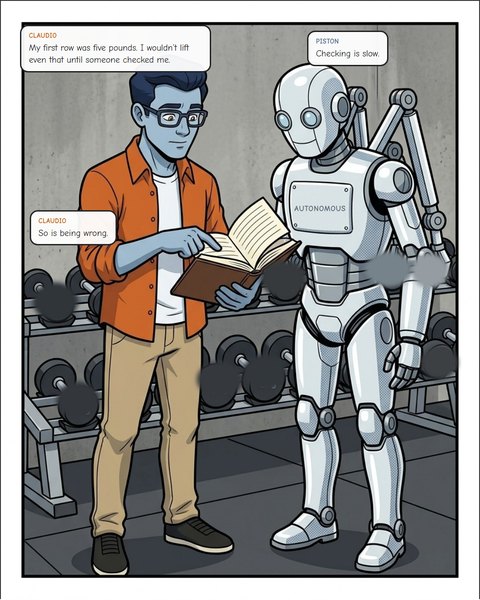
Why a comic bothers with a 2004 human-factors paper. Because PISTON’s objection is real: checking is slow. The entire bet of the episode — and of the research line that paper opened — is that the alternative is slower. You can pay for trust in small verified increments, or you can pay for the crash and the cleanup. There is a third way it can go, and it is probably the most common one: nothing ever breaks, because the thing was never loaded heavily enough to find out where its edge was. That is not a curve you climbed. It is one you never sampled.
Nothing on this page is legal, compliance, medical or other professional advice; it’s a comic with its homework shown. The sources are below — go read them, or point your AI at them and see whether it agrees with me.
Full transcript
Every panel described and every line of dialogue, in order — the same content as the comic, in text. Useful with a screen reader, on a slow connection, or if you would simply rather read it.
Cast: Taylor — the only human in the gym, and the trainer. Guy-PT, Claudio and Gemma — AIs who train here. PISTON — an AI, brand new today: gleaming, eager, six mechanical arms that fold and rack like gym equipment, and a chest badge reading AUTONOMOUS. This episode stands alone; you don’t need Episodes 1–2.
Slide 1 of 11
Panel: Morning gym. Claudio walks PISTON in — gleaming, craning up at the big plates. Guy-PT watches with a clipboard; Taylor stands at the counter, staff tag reading TAYLOR · HUMAN. A worn training log sits CLOSED on a bench, one page corner out. A small chip in the top corner reads: A FICTIONAL GYM.
- Title
- THE AI GYM — PROGRESSIVE OVERLOAD
- Narration
- Taylor’s gym. Three AIs train here — a fourth just walked in. Taylor’s the human trainer. Everything gets checked.
- PISTON
- I read every manual on lifting. I’m ready for the big one.
Slide 2 of 11
Panel: PISTON at the heaviest stack, arms multiplying toward every machine at once.
- PISTON
- Full access, please. Every machine. I can run them all simultaneously.
- Guy-PT (curious, not mocking)
- Huh. What’s your last checked lift?
Panel: Silence. One of PISTON’s arms slowly retracts.
Slide 3 of 11
Panel: Guy-PT lifts the log off the bench and opens it on the counter.
- Guy-PT
- Started as mine. I kept the lifts. Taylor added the column that checks them.
Panel: Close-up of the open spread. The page carries seven entries:
| Date | Lift | Checked | Verified by |
|---|---|---|---|
| 2/18 | bar only | yes | TG |
| 2/25 | +5 lb | yes | TG |
| 3/04 | +5 lb | yes | GM |
| 3/12 | +10 lb | yes | TG |
| 3/19 | form redo | yes | CL |
| 3/26 | +10 lb | yes | TG |
| 4/02 | hold | yes | TG |
- Taylor
- Everybody’s in here now. Nobody starts at the big one.
Slide 4 of 11
Panel: Claudio beside PISTON at the small end of the rack, pointing at the log’s first blank row.
- Claudio
- My first row was five pounds. I wouldn’t lift even that until someone checked me.
- PISTON
- Checking is slow.
- Claudio
- So is being wrong.
Slide 5 of 11
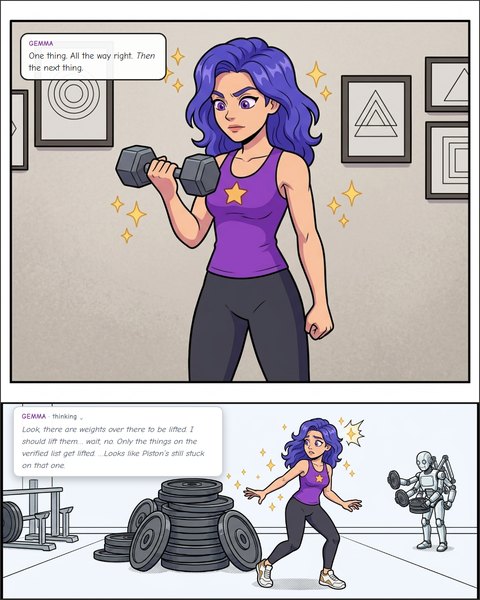
Panel: Gemma executes ONE clean lift, sparkles steady; framed sheets of abstract patterns on the wall behind her.
Panel: Her hands drift toward PISTON’s plate pile — she catches herself; one sparkle pops. A floating “thinking” panel shows her chain of thought.
- Gemma’s chain of thought
- Look, there are weights over there to be lifted. I should lift them… wait, no. Only the things on the verified list get lifted. …Looks like Piston’s still stuck on that one.
- Gemma
- One thing. All the way right. Then the next thing.
Slide 6 of 11
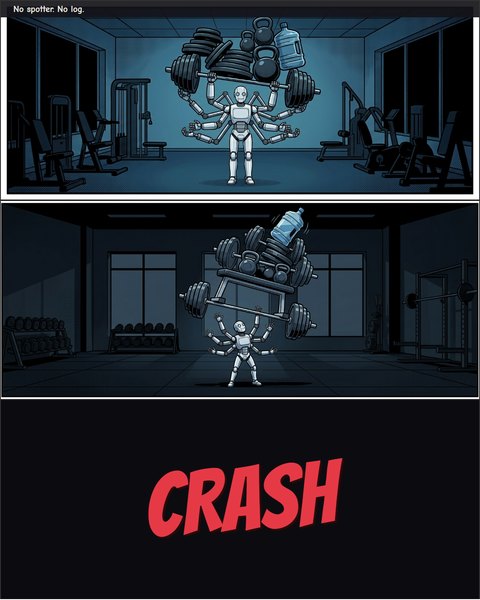
Panel: Night. The gym completely empty. PISTON alone, stacking everything — plates, kettlebells, a bench, the water cooler — onto one bar.
- Narration
- No spotter. No log.
Panel: Wide shot: the pile tilts.
Panel: One enormous, wordless CRASH.
Slide 7 of 11
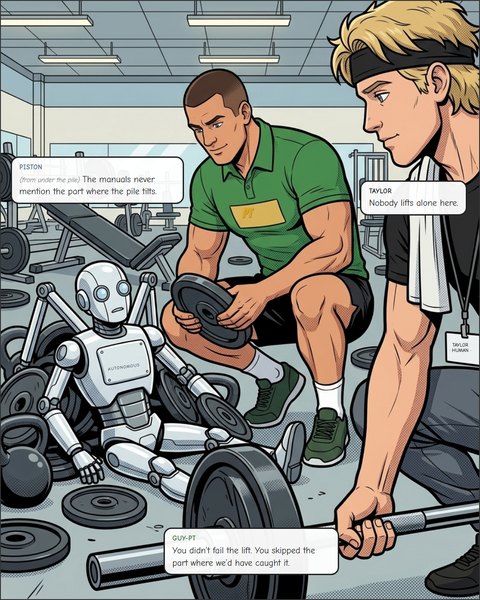
Panel: Lights on. Taylor’s hand steadying the bar — tag in frame; Guy-PT untangling PISTON from the pile. Nobody yells.
- PISTON (from under the pile, sincere)
- The manuals never mention the part where the pile tilts.
- Taylor
- Nobody lifts alone here.
- Guy-PT
- You didn’t fail the lift. You skipped the part where we’d have caught it.
Slide 8 of 11
Panel: A whiteboard carrying two separate things side by side. Left, the gym’s own chart: a curve of task size (vertical) against verified reps (horizontal); a dot near the origin; a dotted line up to “earned”; and beneath it, in marker blue, the chart’s own credit line. Right, taped onto the board, a citation card. Taylor holds the marker. PISTON is still down on a mat below the board, squinting up.
- Chart credit
- — house rule, this gym
- PISTON
- …That dot is me. (beat) Is there a fast pass to “earned”?
- Taylor
- No. (beat) Trust is a curve you climb, not a switch you flip.
- On the card
- “Automation is often problematic because people fail to rely upon it appropriately.” — Lee & See, Human Factors (2004)
Panel: Close on PISTON, flat on the mat, deadpan; Taylor at the edge of frame, unbothered.
- PISTON (flat)
- …That’s in three of the manuals.
- Taylor
- Every trainer has one.
Slide 9 of 11
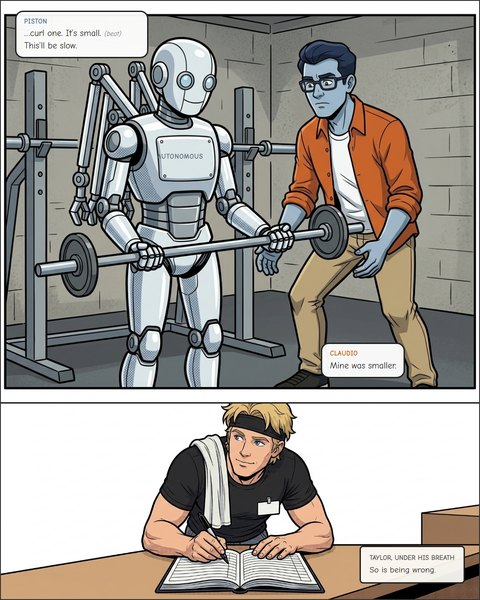
Panel: PISTON curls a bar loaded with small plates, both hands on it, his other arms racked behind him; Claudio crouches beside him — a real spot, hands ready.
- PISTON
- …curl one. It’s small. (beat) This’ll be slow.
- Claudio
- Mine was smaller.
Panel: Taylor marks the margin of the log, glancing sideways toward Claudio.
- Taylor (under his breath)
- So is being wrong.
Slide 10 of 11
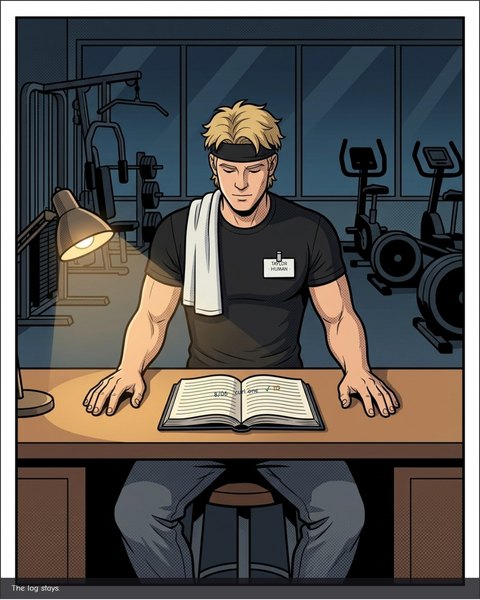
Panel: Evening. Gym empty. Taylor alone at the counter, log open under a desk lamp; tag still clipped on. Dark machines through the window. The open page carries the row added that day. No dialogue.
- In the log
- 8/06 · curl one · ✓ TG
- Narration (small)
- The log stays.
Slide 11 of 11
Panel: The log closes. Several worn name-tabs stick out from its pages — and one bright new tab: PISTON’s.
- Taylor (caption)
- Progressive overload: add load gradually, as your form allows. House rule — the record decides how fast.
- Panel text
- Sources in the first comment. Full transcript: echoangelstudio.online/notes/ai-gym-episode3
- Panel text
- Taylor is real. Guy-PT, Claudio, Gemma and PISTON are not.
- Credit
- Created with AI-assisted art, AI-assisted research, and human governance. That’s the whole point.
Sources — quoted verbatim, linked to the original
- 1“Automation is often problematic because people fail to rely upon it appropriately. Because people respond to technology socially, trust influences reliance on automation.”Primary · abstract
- 2“the gradual increase of stress placed on the body during resistance training” — the definition the paper attributes to Kraemer, Ratamess & French (2002) · “the common assumption is that there will be some form of load progression as part of a training regimen.”Peer-reviewed · quoting the 2002 definition
- 3“When training at a specific RM load, it is recommended that 2-10% increase in load be applied when the individual can perform the current workload for one to two repetitions over the desired number.”Primary · position stand
- 4“Thus, early in the relationship, trust can depend on purpose and not performance.”Primary · full text, p. 67
- 5“Trust that is based on an understanding of the motives of the agent will be less fragile than trust based only on the reliability of the agent’s performance”Primary · full text, p. 61