What this piece claims, up front: that a decision record was written contemporaneously and is recoverable after the fact by a read-only query, decoupled from the run that produced it. That is all. It does not claim to prove the model's true internal reason, that the record is tamper-evident, or that such records are comparable across re-runs. Those boundaries are the point, and they're named plainly below.
A promise, turned into a check
This studio makes a promise on its front page: traceable results — you can follow the chain from source to conclusion. This piece takes one corner of that promise — the traceability of a decision — and turns it from a claim into something you can check yourself.
The usual question people ask about AI is “is the model right?” It's the wrong question to build accountability on, because you often can't answer it in the moment. A more answerable question — and, when something slips, a more useful one — is: if it wasn't right, can you recover what it decided, and the reason it recorded at the time?
Here, the answer is yes, and the demonstration is deliberately humble: an ordinary grocery workflow, an ordinary miss, and a record that was already sitting in a database waiting to be queried. The interesting part isn't the mistake. It's that the reason was recoverable — and that being honest about a record like this means being just as clear about what it doesn't establish.
What happened
The workflow is the tail end of a chain of free, USDA-grounded nutrition tools: a gram-based home cookbook, and a weekly grocery-list engine that turns a meal plan into a single, store-sectioned shopping list. The last step is the one that matters here — an AI agent assembles that list into a cart in a real, logged-in grocery account, and a human reviews and completes every purchase. A person, not the agent, does the buying.
One week, a recipe called for sesame seeds. They never made it into the cart. Not a dramatic failure — a small, ordinary one. Which is exactly why it's a safe place to look closely: the method is what generalizes, and you want to learn it on a case where nothing is at stake.
The reason was already on record
Here's the part that matters. At the time it built the list, the agent had recorded an assumption it was working from: that small pantry staples like sesame were already on hand. That note wasn't reconstructed after the fact or inferred later — it was written as the work happened and stored as a single row in the orchestrator's database. Weeks afterward, I pulled it back out with an ordinary read-only query.
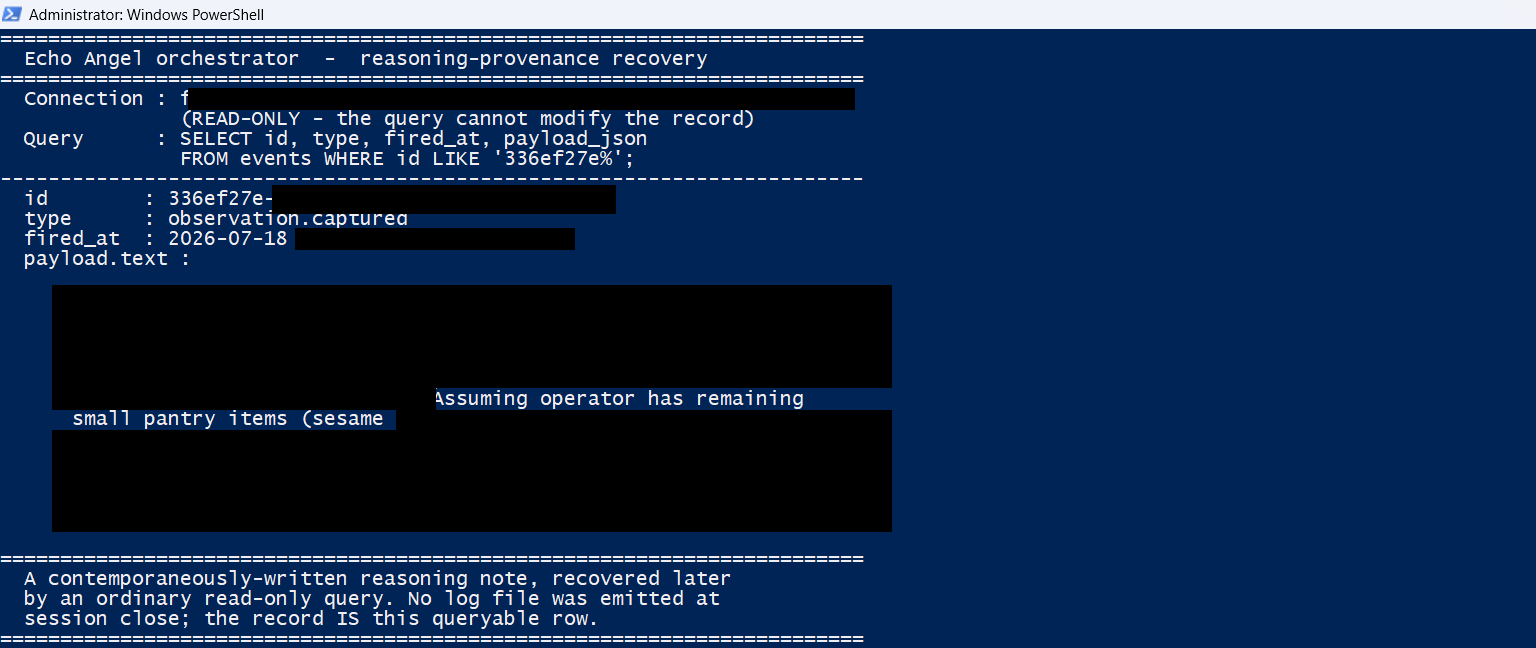
?mode=ro). The connection path, the exact timestamp, the full payload, and the row's identifier tail are opaque-filled; the assumption itself is what's on the record.
image sha256: 0f80bc1770f03d365f310202064807124638d53b4fba4b25e8ee277a73d19390
Read this record honestly — three things it is, and isn't.
- It's the recorded assumption, not the proven cause. The record states that the agent assumed pantry staples were on hand. I'm not claiming to know why the model inferred that, or that the assumption is the true cause of the omission — only that it was there, in writing, at the moment the decision was made.
- The failure was a human one: approval by habit. The assumption wasn't hidden. It was surfaced at the human-review step — and a human (me) clicked approve all. That's the failure mode worth naming: not a machine inventing something, but an unverified assumption waved through at the exact moment review was supposed to happen. Traceability didn't catch a hallucination; it located a rubber-stamp.
- The stakes are tiny on purpose. The value here isn't the sesame seeds. It's that the record let me find the exact spot the miss entered — which is the concrete thing a record like this buys you: surface the inferred-but-unverified assumptions at the approval window, so the next “approve all” is a decision, not a reflex.
On that hash. The screenshot above is content-hashed, and it's worth being exact about what that does and doesn't buy you. The hash shows the image file hasn't been altered since it was captured. It does not prove the underlying record is genuine, or that its timestamp is true. So don't take the screenshot on faith — the next-but-one section lets you reproduce the whole mechanism yourself, which is the honest way to earn that trust.
The record is a database, not a log file
A natural assumption — one I've caught myself repeating — is that a system like this “writes a log file when the session ends.” It doesn't. No log file is written at close. The record is the database the whole time: sessions, phases, and events. A reasoning note is just one row in the events table — a type, a timestamp, and a JSON payload. The readable “session log” is reconstructed from those tables on demand. It's a view, not a file.
sessions
- idPK · uuid
- numberint
- started_atdatetime
- closed_atdatetime?
- labelstr?
- content_modefull · meta
phases
- idPK · uuid
- session_idFK
- namestr
- intenttext
- started_atdatetime
events holds the trace
- idPK · uuid
- typestr
- session_idFK
- phase_idFK
- fired_atdatetime
- payload_jsonjson
One detail on this table is load-bearing for the honesty of the whole piece: the events table has no hash column. These rows are a genuine contemporaneous record, but they are not, by themselves, tamper-evident. (Integrity of that kind lives in a separate layer, whose mechanism isn't published here; it registered session records only until July 10, 2026, and not this one.) I'd rather you see the gap than have me paper over it.
A small confession, kept on purpose. I know it doesn't emit a log file because I checked the code — not my memory of it. An earlier description of mine had drifted from what the system actually does. That's the same discipline this piece is about: trust the artifact, not the storyteller. Which is why the next section hands you the artifact.
Where the miss entered
Laid out end to end, the pipeline makes the honest point visible: the failure isn't at the model. It's at the human-approval node, where a recorded assumption was approved without a check.
Recover it yourself
A case study about verifiability shouldn't ask you to trust its screenshots. So here's the actual mechanism, on a small, fully synthetic, zero-PHI database with the same shape as the real one. Download it, run one command, and recover a contemporaneous decision record yourself — a reader-runnable demonstration of the one thing this piece claims: that the record exists and is recoverable, read-only.
# recover.py — recover a contemporaneous decision record, READ-ONLY
import sqlite3, json

# mode=ro : strictly read-only — the query cannot create or modify the database
con = sqlite3.connect("file:record.db?mode=ro", uri=True)
row = con.execute(
    "SELECT id, type, fired_at, payload_json "
    "FROM events WHERE type = 'observation.captured'"
).fetchone()
con.close()
# prints the recovered id, type, timestamp, and the reasoning note in the payload
What running it shows — and what it doesn't.
- Shows: the record was written at decision time, stored as one row, and is recoverable by an ordinary read-only query (the connection is opened
?mode=ro— try aDELETEand SQLite refuses: attempt to write a readonly database). No separate log file; the record is the row. - Doesn't show, and isn't claimed: that the recorded reason is the model's true internal cause; tamper-evidence of the row; or stability of such records across non-deterministic re-runs. Those are out of scope, on purpose.
What this is — and isn't
This case study sits downstream of a field note published earlier on this site, “A faithful log of an unfaithful trace.” That note maps an agent's records against ALCOA+, the data-integrity framework used in regulated industries, and lands on an uncomfortable cell: a reasoning record can be perfectly contemporaneous — logged, time-stamped, captured as emitted — and still not be the true account of why the agent decided what it did. In the note's own table, a contemporaneous reasoning capture proves “the narrative existed at decision time” but is, in its exact words, “necessary, not sufficient.”
So here is precisely what this case study is, and nothing more: a worked illustration of the contemporaneous-and-recoverable leg of that record, caught in a real workflow. The note described a fuller record — contemporaneous, tamper-evident, and cross-run-comparable — that “isn't built yet.” This illustrates one part of it and leaves the other two — tamper-evidence and cross-run comparability — explicitly unbuilt. It does not close that problem.
Named plainly as out of scope — the legs this does not demonstrate:
- The true cause. That the recorded reason is the model's actual internal cause is explainability, and the field note shows why that boundary is leaky. This piece stays on the record, not the cause.
- Tamper-evidence of this record. The
eventsrows aren't hash-chained; a separate integrity layer, whose mechanism isn't published, registered session records only until July 10, 2026 — not this one. Don't read the recovered row as tamper-evident. - Cross-run comparability. Whether such records are stable enough to compare across non-deterministic re-runs is the field note's hardest open question — not demonstrated here.
This piece was checked against the shipped code (no log file is written at close; the events table carries no hash column) and passed a separate, in-studio adversarial review before publishing — a distinct pass, not a third-party audit. Its one job is to be honest about a small true thing.
Where this fits
One sentence of positioning, held humble: the architecture behind this is a deliberately unusual set of trade-offs — the only model in the loop is the user's own, and verification recomputes at the export step rather than being asserted after the fact — which is a different architecture, not a claim to beat the serious work others are doing on AI auditability. The reframe worth keeping is smaller and sturdier than any product pitch: stop asking only whether the model was right, and start asking whether its decisions are recoverable — because that is the question you can actually check, on a Tuesday, over a jar of sesame seeds.
Related work
If this way of thinking is useful, a few neighboring pieces go deeper — all public, all checkable:
Work you can check, not take on trust
This case study was built so a skeptic can interrogate it — the recovery runs on your machine, not ours. If that's the kind of AI work you need, let's talk.
Get in touch View more projects